

Your gutters collect the rain, but it is the downpipe that gets it safely to the ground. Pick the wrong size or leave out a fitting and you will get overflowing gutters, damp walls or water pooling against your foundations. This guide explains downpipe sizes, types and fittings, how many downpipes you need, and how to fit them.
What Is a Downpipe?
A downpipe (also written down pipe, and called a rainwater pipe or downspout) is the vertical pipe that carries rainwater from your gutter outlet down to a drain, gully or soakaway. Together, gutters and downpipes make up your home's rainwater system, so the two need to be the same brand, profile and colour to fit properly.
Parts of a Downpipe System
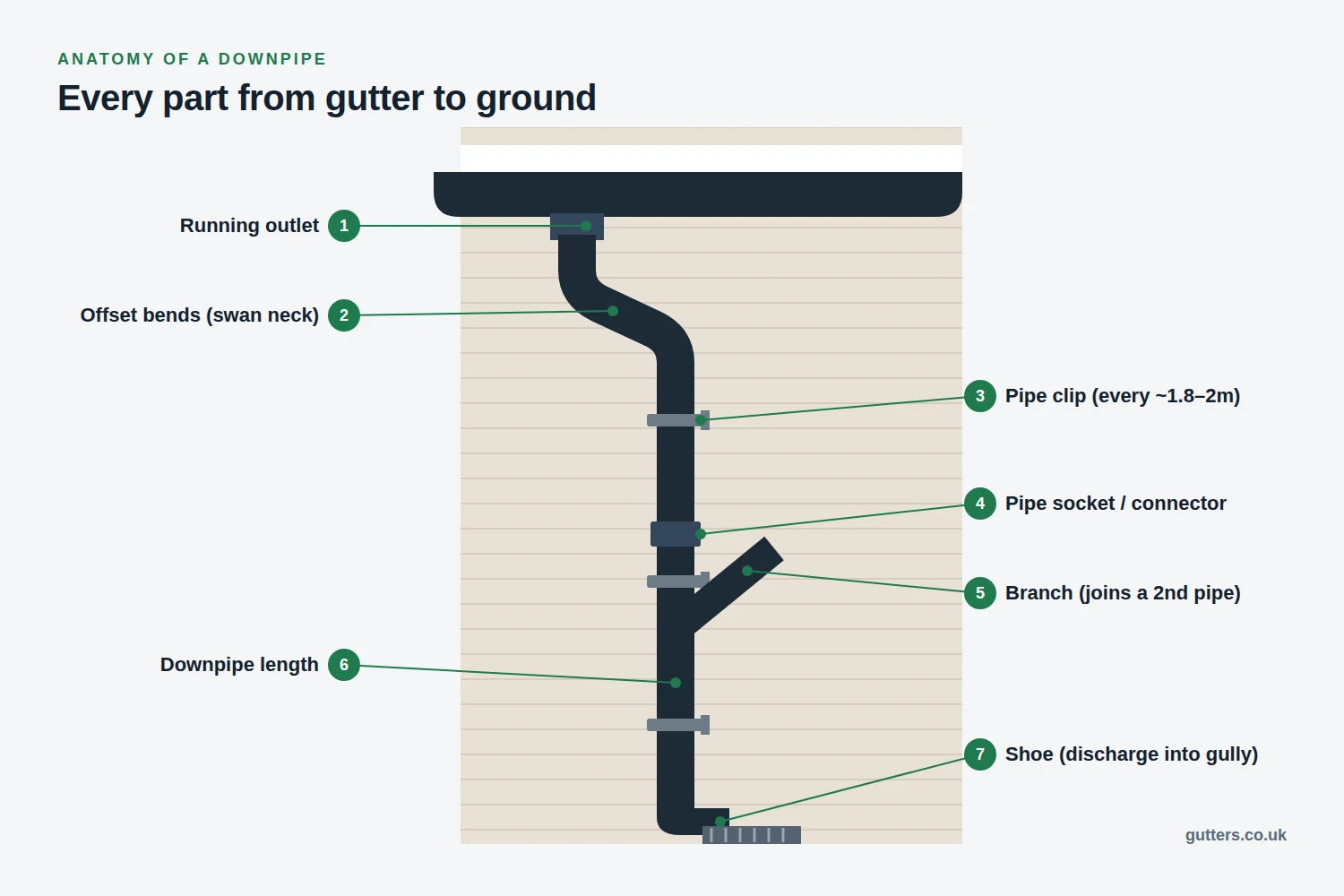
A typical house downpipe is made up of these parts, from the top down:
- Running outlet – the gutter fitting with a spigot that the downpipe connects to.
- Offset bends – usually two 112.5° bends joined with a short offcut of pipe to create a “swan neck”, bringing the pipe back from the overhanging gutter to the wall. See the FloPlast 68mm offset bend or Osma 68mm offset bend.
- Pipe clips – hold the pipe to the wall, such as the FloPlast 65mm square pipe clip.
- Pipe sockets / connectors – join two lengths of pipe.
- Branches – join a second downpipe into the first, for example from a bay window or extension roof.
- Hoppers – open funnels that collect water from more than one pipe, like the Brett Martin cast iron style hopper. See all cast iron style hoppers, cast iron rainwater heads and copper hoppers.
- Shoe – the angled fitting at the bottom that directs water into the gully or away from the wall, such as the Brett Martin 68mm round pipe shoe.
- Pipe adaptors – connect the downpipe to an underground drain or a different pipe size. Browse our downpipe adaptors.
Downpipe Sizes: What Size Downpipe Do I Need?
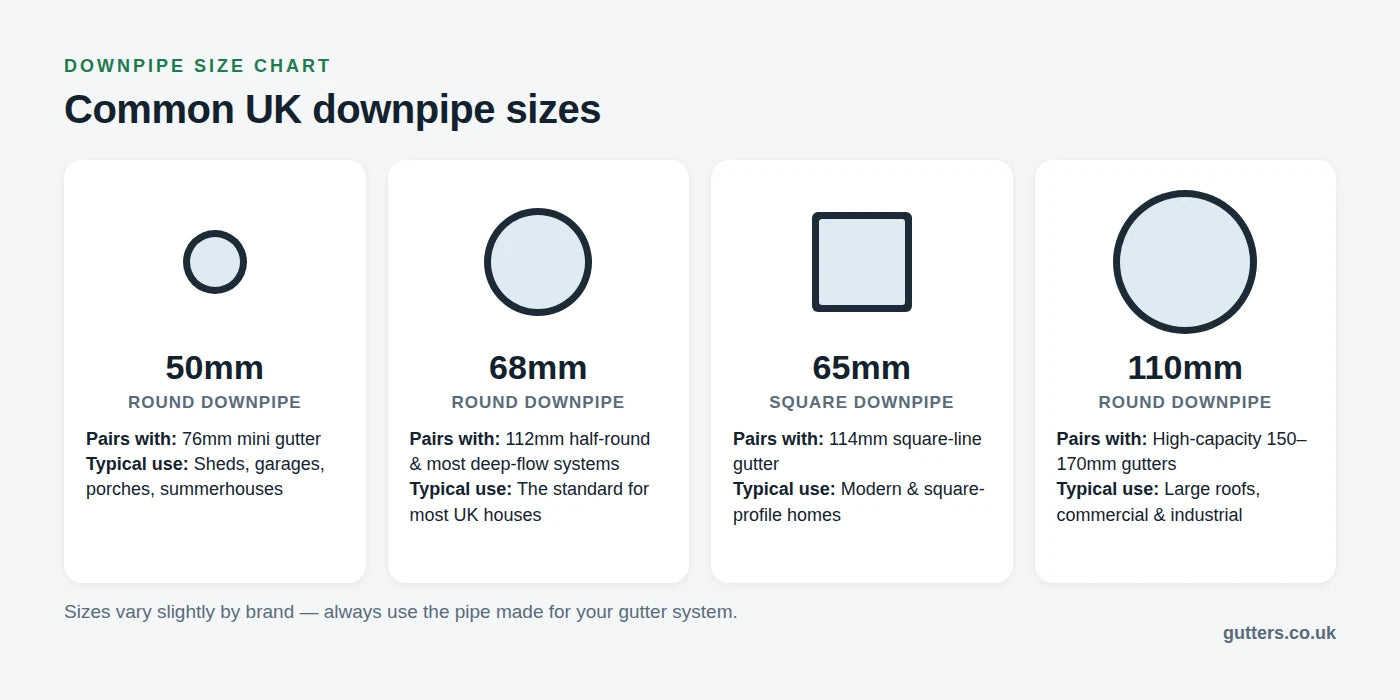
Downpipe size is set by your gutter system. These are the most common UK sizes:
- 50mm round – used with 76mm mini guttering on sheds, garages, porches and summerhouses. See FloPlast 50mm round pipe.
- 68mm round – the standard downpipe for most UK houses, used with 112mm half round and most deep flow gutters. See FloPlast 68mm round pipe and Osma 68mm RoundLine pipe.
- 61–65mm square – used with square line gutters (around 114mm). See FloPlast 65mm square pipe, Marshall Tufflex 65mm square pipe and Osma square pipe.
- 80–110mm round – used with high-capacity gutters of 150–170mm on large roofs and commercial buildings. See FloPlast 110mm pipe and Osma 110mm pipe.
Exact sizes vary slightly between manufacturers, so always use the downpipe made for your gutter system. Not sure what you have? Our guide to what size guttering you need explains how to measure it.
Types of Downpipe Material
PVC (uPVC) downpipes are by far the most popular in the UK. They are light, inexpensive, need no painting and come in black, white, brown, grey and anthracite. Brands include FloPlast, Osma and Marshall Tufflex — see our full PVC guttering range.
Cast iron style PVC gives the traditional look of cast iron without the weight or maintenance, ideal for period homes. See Brett Martin Cascade 68mm round and FloPlast cast iron style round pipe.
Cast iron downpipes are heavy and extremely long-lasting, and are often required on listed buildings and in conservation areas. See cast iron round pipe and cast iron rectangular pipe.
Aluminium downpipes offer a premium, low-maintenance metal finish. See Alumasc Heritage cast aluminium and Marley Alutec Evolve.
Steel and copper downpipes suit modern and architectural designs. See Lindab steel round pipe and copper round downpipes.
How Many Downpipes Do I Need?
The number of downpipes depends on roof size, roof pitch and your gutter's flow capacity. As a general guide:
- A typical semi-detached or terraced house needs one downpipe per roof slope, usually at one end of the gutter run.
- Placing the outlet in the centre of a run, rather than at one end, lets the gutter drain in two directions and roughly doubles the area it can handle.
- Long runs, large roofs and steep pitches may need two or more downpipes, or a higher-capacity system such as deep flow guttering.
- If your gutters overflow in heavy rain even when clean, you may need an extra downpipe or a larger gutter.
Manufacturers publish flow tables for each system, and our team can help you work out the right number for your roof.
How to Fit a Downpipe
- Fit the gutter and outlet first. The running outlet should sit directly above the drain or gully where possible. See how to install PVC guttering.
- Make the swan neck. Push an offset bend onto the outlet spigot, measure the gap to the wall, cut a short offcut of pipe to suit and add the second offset bend so the pipe sits flat against the wall.
- Mark a plumb line. Use a spirit level or plumb line to mark a vertical line down the wall from the swan neck to the drain.
- Fix the pipe clips. Fit a clip at every socket joint and at intervals of no more than around 1.8–2m, following the manufacturer's guidance.
- Cut and join the pipe. Cut pipe square with a fine-toothed saw, remove burrs and push lengths into the sockets. Leave a small expansion gap (around 10mm) at each socket on PVC pipe.
- Fit the shoe or drain connector. Finish with a shoe discharging into a gully, or a pipe adaptor connecting straight to an underground drain.
Always work from a safe, stable ladder. We stock ladders suited to gutter and downpipe work.
Common Downpipe Problems
Blocked downpipe: usually caused by leaves and moss washing in from the gutter. Signs include water overflowing at the outlet and gurgling in the pipe. Clear it from the bottom by removing the shoe, then prevent repeat blockages with a balloon outlet guard — see our guide: gutter guards: do they work?
Leaking joints: a split socket or missing clip lets water run down the wall. Replace the damaged fitting and add clips where needed.
Pipe pulling away from the wall: usually a failed or missing clip. Refit with new plugs and screws, and check the clip spacing.
Water splashing against the wall: fit a shoe angled away from the wall or connect the pipe directly into the drain.
Downpipe FAQs
What is the standard downpipe size in the UK?
68mm round is the most common downpipe size for UK houses, paired with 112mm half round guttering. Square line systems typically use 61–65mm square pipe.
Can I mix brands of downpipe and gutter?
It is best not to. Sizes and socket designs differ slightly between brands, which can cause poor fits and leaks. Stick with one system from gutter to shoe.
Where should a downpipe drain to?
Rainwater should go to a surface water drain, soakaway or water butt. In most new work it should not be connected to the foul sewer; check with your local Building Control if in doubt.
How far apart should downpipe clips be?
Most PVC systems need a clip at every socket and at intervals of around 1.8–2m. Always follow the manufacturer's fitting instructions.
Can I connect a downpipe to a water butt?
Yes. A rainwater diverter fitted into the downpipe sends water to a water butt and lets excess carry on to the drain once the butt is full.
Browse our full range of gutter and downpipe systems, or explore gutter accessories. If you need help matching a downpipe to your existing gutters, get in touch with our team.